Wednesday, 11 November 2020

What The Headlines Didn't Tell You About Ofsted's Latest Covid-19 Report

Ofsted published a new report about the impact of Covid-19on education and here’s what you know: kids are back in nappies, they eat food with their fingers and they’ve played too many online games and are now falling out about it.

Here’s what, if you haven’t read the full report, you probably don’t yet know: some children have been more exposed to domestic violence, there has been a rise in self-harm and some children have become more involved in crime. But those are just some of the most concerning, negative outcomes of the pandemic for some young people.

Here’s what else you might not know, according to Ofsted: the vast majority of children have settled back into school, are being taught a broad curriculum and leaders and teachers are doing an excellent job of adapting necessarily with positive results.

But that sort of stuff does not a headline make, does it?

Wellbeing

When it comes to wellbeing of pupils, the report is clear: ‘leaders said that their pupils were generally happy to be back, and had settled in well.’

The report also records that ‘leaders in most schools continued to report that pupils were happy to be back. Pupils were described as confident, resilient, calm and eager to learn. There was a general sense that they appreciate school and each other more. Many leaders noticed that behaviour has generally improved… Many emphasised that fewer pupils were needing additional support than had been anticipated.’

Imagine the headlines we could have had: Pupils return to school with confidence and resilience! Children eager to learn as they get back to school! Students defy expectations in calm return to education!

In addition, Ofsted identify that schools are going above and beyond in their response to ensure that pupils are happy and able to deal with the changes the pandemic has brought: ‘Many schools of all types reported a greater focus than usual on their personal, social and health education (PSHE) curriculum to develop aspects such as resilience and independence and to reinforce or improve learning behaviours, but also to address pupils’ anxieties. Some schools were also strengthening their PE provision to support pupils’ physical and mental well-being.’

And it’s not only children who have got back to school and got on with doing a great job, it’s the staff too, according to the report: ‘Leaders said that their staff have generally adapted well to various changes, and are working hard to make these work. They attributed this to frequent and effective communication with staff as well as to a stronger sense of team spirit that has emerged over the last few months.’

Further potential headlines for your delectation: School staff working hard to adapt to changes! Strong sense of team spirit seen in schools!

And perhaps being at home hasn’t been such a bad thing for children anyway; perhaps it isn’t just the fact that they are finally back at school which has made for such positive changes: ‘Many leaders spoke positively about pupils with SEND returning to school. In a couple of schools, leaders noted that additional time spent at home had been positive for pupils with SEND, who had returned with confidence.’

Attendance

One of the fears of school leaders in the summer was most certainly around what attendance would look like come September. Fears have been allayed, according to Ofsted’s report: ‘Around three quarters of the schools visited reported having attendance that was similar to, or higher than, this time last year… where attendance had improved, leaders often attributed this to the work that they had done to build families’ trust during the first national lockdown, and their continued efforts to inform and reassure parents about the arrangements they had made to keep pupils safe in school.’

More headlines: Home-school relationships improve: attendance rises! 2020 Attendance higher than ever!

And Ofsted even acknowledge just how thoughtful and flexible school leaders are being in their commitment to children: ‘Leaders described how they were working closely with parents and offering flexible arrangements if these were needed to help pupils to return as soon as possible.’

Curriculum and Remote Learning

Much was said during lockdown regarding ‘gaps’ that would appear in learning. I’m sure many school leaders considered whether or not to slim down their curriculum, providing what might amount to an insubstantial education which did not develop the whole child.

However, what Ofsted have seen is that leaders are ambitious to return their schools to their usual full curriculum as soon as possible, that most of the secondary schools were teaching all their usual subjects and that many of the primary schools they visited were teaching all subjects.

Another favourite subject of lockdown discussion and thought was remote learning. Public figures weighed in with their ideas, as did parents, teachers and students. Would schools be able to truly provide remote education to a suitable standard?

Well, Ofsted have found that ‘almost all schools were either providing remote learning to pupils who were self-isolating or said that they were ready to do so if needed’ and that most schools ‘were monitoring pupils’ access to the work provided or attendance at the remote lesson.’

They also report that leaders are responding well to their findings, particularly that ‘during the first national lockdown, pupils reacted very positively when there was live contact from teachers, so want to build on that when needed.’

And again, leaders are adapting well to the new circumstances, thinking outside of the box and ensuring that staff wellbeing is a priority: ‘Leaders in a few schools explained how they were trying to mitigate the additional demands on staff of providing remote learning, for example through the help of teaching assistants, or having staff who took a particular role in leading or modelling remote education.’

A further possible headline: Schools found to be providing full curriculum and good remote learning!

CPD

Remember how teachers were all lazy during lockdown and should have been back at work? Well, turns out, they were actually working really hard (surprise, surprise), not only providing aforementioned remote learning but also taking the opportunity to sharpen their skills en masse: ‘staff in many schools seized the opportunity for training and development during the months when most pupils were not physically in school.’

Now that certainly won’t make the headlines: Teachers work hard despite perception of journalists!

Learning ‘Loss’

And finally to the big one: have children fallen behind? Are their gaps in their learning? Academically, has Covid-19 set children behind where they should be?

Well, much is said in the report regarding this, however a key takeaway should certainly be the following:

‘In the mainstream schools visited, there was no real consensus about the extent of pupils’ learning loss as a result of the disruption to their education.’

Correct headline: No consensus on Covid learning loss!

This is where the main criticism of the report might come: it is written in such a way that the negative is the focus.

For example, the report makes it clear that some leaders commented that writing was also an issue for some pupils, including writing at length, spelling, grammar, presentation, punctuation and handwriting.’ And it is this that then hits the headlines, with the ‘some’ removed, of course. Such a statement becomes ‘Children forget how to write during lockdown’ when it is headlinified.

Indeed, the inverse statement surely is equally as true: ‘Most leaders commented that writing wasn’t an issue for most pupils, including writing at length, spelling, grammar, presentation, punctuation and handwriting’ or even ‘Most leaders didn’t comment on writing being an issue for most children.’

Yes, it is right for schools to identify the negative impact of the pandemic so as to make progress with children who have been affected, but at the same time the positive impacts and the huge amount of work that has already been done in this vein should surely be celebrated more widely.

Not just for the benefit of hardworking school staff either – as a parent I want to be reassured by both Ofsted and the media that schools are doing a great job with my children. Thankfully, I don’t have to rely on them to form my opinion: I know for certain my children’s school is doing a fantastic job, and I know the school I work in is too.

Thursday, 1 October 2020

Tonight Matthew, I'm Going To Be... A Director

This COVID has certainly put a spanner in a few works; one such spanner being year 6 open evenings at secondary schools. 

A parent of a year 6 child myself, this is a huge concern for me - how do we pick the right school for her, especially given that this is the first time we are sending a child off to big school? With my responsibilities across both KS2 and KS3 I wanted to help to make sure that what our school offers to prospective children and parents would help them to understand better what our school is like.

So, on top of the content that was already being produced for online viewing (virtual tour, promo video, message from the principal etc), I decided to give both year 6 and new year 7s a voice - after all, they're the ones its all about. It's all very well having members of staff present information, but children want to hear from their peers too - they're the ones who will tell them what it's really like.

And that's why this morning I was directing, alongside our tech-savvy media guy, an extra bit of video content where year 6 children got the chance to ask year 7 children some of their own questions. With bubbles we couldn't get them in the room together so we had to film the year 6s asking their questions first and then the year 7s answering the questions (with me asking the questions this time). Hopefully once it's all edited together we will have a seamless FAQ video for children and their parents to watch in order to get a more rounded picture of what's on offer.

The year 7 children presented confidently, embodying our values and showing that in just a few short weeks they have really settled in well and got to know the ropes. They were able to articulate positively much about their experience so far -  a testament to the hard work of the team of staff leading and teaching in year 7. And all this in spite of all the difficulties surrounding transition and the return to school that COVID has presented us with.

Teachers and leaders play many roles under normal circumstances - the positive view of COVID is that it is most certainly providing us with further strings to our bows!

Monday, 28 September 2020

Tonight Matthew, I'm Going To Be... A Gallerist

It's a fairly well accepted concept that a teacher is so many more things than a teacher - that a teacher puts on many different hats even during the course of one day. I think the same is true for school leaders too.

For a part of today I found myself acting as a gallerist, or a curator.

We have, as many primary schools probably do, many, many display boards around school. Too many, perhaps. And what happens to display boards when teaching staff are getting on with teaching and doing the important stuff? The content sometimes gets a bit old. That or teachers have to spend time out of class, or out of hours, putting up displays - something that, in my opinion, really should be minimised if we care about our children and staff at all.

So there I was double-sided taping the large art prints I'd order to black paper, gluing the accompanying information I'd collated and trimming it as perfectly as I possibly could. I was in 'the studio' overlooking 'the heartspace' off which many of our classrooms are situated. I could see and hear school going on all around me - I noticed this because I suppose I was desperate to legitimise the time spent gluing and cutting and stapling. I could almost feel the calm, purposefulness of what was going on through each of those doorways and in all honesty I wondered if what I was doing was worthwhile.

Afterall, I'm a deputy head - shouldn't I be doing something else? Did these Eric Ravilious, Georgia O'Keefe and Jacob Lawrence prints really need backing and putting up by me? Yes, I told myself, they did - because this is one of the many problems of being a perfectionist: you learn very quickly that there are some things you just have to do yourself. And yes, because for all intents and purposes, I am the art lead in the school and it is my job to educate staff and children in matters relating to the arts. 

And actually, yes, because I have to balance out some of the other less desirable things I have to do with things that are actually enjoyable - this for my own mental wellbeing. Besides, what was I actually thinking about all that time? Well, many confidential things that can't be repeated on my blog: I was providing myself with time and space to think through the issues of the day - the things that were on my mind over the weekend, the difficult conversations that need to be had, the logistical problems that need working through. 

On the outside I was cutting and sticking, on the inside I was doing what I'm really paid to do: lead.

If I were to go from one high pressure situation to another, never allowing myself down time doing jobs that seem a little more menial, would I really be properly ready for the next meeting, the next time someone brings a problem to me or the next time I have to deal with a behaviour issue? I think not.

So, some thinking got done - hopefully preparing me for the future - and some nice (I think) displays were created in the process.

Yeah, I'm OK with being a gallerist.

Thursday, 6 August 2020

Book Review: 'The Monsters of Rookhaven' by Pádraig Kenny

As a pair of down-on-their-luck siblings, Jem and Tom, stumble through a tear into the hidden grounds of an eerie manor house, the reader is drawn through the closed doors of Rookhaven and into a world of intrigue. In fact, the reader almost becomes Jem as the story focuses less on her and more on what she discovers as she spends more time with The Family.
With great skill Pádraig Kenny sets to work, in the subtlest of ways, weaving motifs and feelings seemingly drawn from classic and contemporary literature and film. The effect of this is highly successful - in an instant the reader will feel a comfortable discomfort as intertextual synapses spark reminiscences and remembrances of other stories they have experienced. The magic that Kenny weaves is all in the fact that despite the nods and references, 'The Monsters of Rookhaven' feels like a highly original piece of work - indeed, one that had me on the edge of my seat.

Perhaps the reason for this is that 'The Monsters of Rookhaven' turns some of the most common classic horror* tropes on their head. Like Shelley's Frankenstein, the 'monsters' are misunderstood and there is more to them than meets the eye. One particular character, Piglet, who is a key player in the events of the book, is a monster who, locked up for years, never seen even by the others in The Family, has a secret weapon and it is most certainly not what you think it is. And it is this secret weapon which brings the story to a beautiful, healing, albeit highly dramatic, conclusion.

The illustrations in this book more than warrant their own paragraph in this review: the black and white woodcut print-style illustrations of Edward Bettison are something else. The images lend real gravitas to the story, giving 'The Monsters of Rookhaven' a real classic feel and making the cover stand out from the current pack of more contemporary-looking children's books. The double page spreads are excellent, providing a feast for the eyes yet not revealing unnecessary details which are best left to the reader's mind's eye - this really is a masterclass in illustration for books aimed at this age range.

One of the enjoyable aspects of this book is that it is just a brilliantly told adventure with just enough magic to be believable and exactly the right amount of elaboration to keep a reader guessing whilst feeling like they get it - I enjoyed reading a children's book that didn't appear to be moralising as I read it. However, once finished, I was left with an understanding: empathy is the enemy of division. I hadn't realised as I read that here was a tale of how communities can be divided, and how certain influential characters can use this division to their own ends, to the point where they provoke and stir up dissension - certainly a tale for our times. And I applaud Pádraig Kenny for this, his ability to leave the reader be as they read but to leave them with life-changing message.

*although this book is influenced by some classic horror and sci-fi it is not at all too scary for its intended audience of Middle Grade readers.

The Monsters of Rookhaven by Pádraig Kenny and Illustrated by Edward Bettison is out on 17 September 2020 (ISBN: 9781529031492)

Wednesday, 5 August 2020

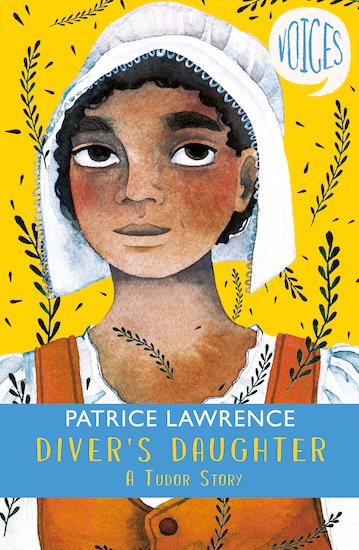
Book Review: Diver's Daughter by Patrice Lawrence

I've previously reviewed two other books from Scholastic's Voices series (here and here) and, after reading the first, I did not intend to stop there. 'Diver's Daughter' by Patrice Lawrence was next on the list.

Not exactly based on a true story, but involving one very real and pivotal character, this book is rooted in the true, often untold history of Black people in Tudor England. Having read the section in David Olusoga's Black and British that dealt with the Tudor period I had recently become more aware of the fact that there were hundreds of people from Africa or of African descent living in Britain in the 16th Century.

Eve is a Black Londoner, living, at the beginning of the story, a poor life in Southwark with her mother, a Mozambican by birth. Moving around, getting work where they can, they dream of a better life. Eve's mama is a diver and, faced with a chance to earn some real money in Portsmouth where the Mary Rose has sunk, they make a perilous journey in order to attempt to make their fortune, or at least in search of a better living. Along the way they are beset by illness, untrustworthy companions and ultimately, by their poor circumstances.

Upon arrival, things seem to look up for while, but not for long. The pair struggle to find work, and even the famous African diver Jacques Francis (historically significant not only as being lead salvage diver on the sunken Mary Rose, but also as the first Black person recorded to have given evidence in an English court) doesn't want to help them. They suffer the rejection of the townsfolk, betrayal by supposed friends before the racist viewpoints of the time lead to the kidnap of Eve's mama.

As well as being a thrilling, albeit sad, adventure, the book also evokes many other details of a time gone by - descriptions of living conditions, architecture and every day life as well as explanations of royal lineage and the tussle between religion and politics all ensure that young readers might even learn a thing or two as they read.

Providing, as I believe is the purpose of this range of stories, a way into Black British history for Key Stage 2-aged readers, this book is a great starting point for more learning around the ethnic diversity of Britain in Tudor times. Expertly written and exceedingly evocative, Patrice Lawrence's compelling narrative reveals, in a palatable way, the harsh realities of living in historical England as someone who is part of an ethnic minority group. A must for bookshelves at home, at school and in libraries.

Tuesday, 4 August 2020

Book Review: 'The Infinite' by Patience Agbabi

'The Infinite' by Patience Agbabi felt like a very unique read. What made it unique, I asked myself as a I read it - it was clear right from the beginning that this was something else.

Well, perhaps, it is the fact that you are plunged headlong into a world which at first, you do not understand. And there are layers to this world.

Perhaps the one layer is to do with the fact that Elle lives with her Nigerian grandmother - beautiful snippets of Nigerian culture are scattered throughout the story. Obviously some readers will understand and identify with this, but for this White British reader it was a great opportunity to learn more. I was, however, able to identify with Elle's grandmother's strong Christian faith - another thread that runs through the book.

The next layer to the world that the reader enters upon opening up 'The Infinite' is that Elle has some un-named additional needs. Given that the story is told from a first person perspective, this comes into play a lot. As such, characterisation is strong: the reader really gets to know Elle. We know she needs to sit under tables in certain situations; we know sometimes she spends days without speaking as she deals with trauma. And in this way, understanding of the world Elle inhabits grows as progress is made through the book. It's not only the protagonist who is characterised well - Elle's first person narrative is open and honest - she speaks the truth about the people she encounters in the story meaning that the reader builds up a great picture of the diverse cast of Elle's friends and acquaintances.

And then there is the fact that Elle is a Leapling - one who is born on the 29th of February - who has The Gift - specifically, the gift of being able to time travel. It takes some time to adjust to what is actually a very well-thought-through concept of time travel, and it is this that will draw any curious reader further into this book. Essentially, this is crime fiction, but very much complicated by the fact that crime can happen across time if perpetrated by others with The Gift. The story concludes satisfyingly and logically - a testament to the fact that the parameters of Agbabi's concept of time travel are very well-communicated throughout the book.

'The Infinite' is a really inventive, imaginative and innovative book - I've certainly never read anything quite like it. Highly recommended.

Sunday, 26 July 2020

Book Review: 'Spaghetti Hunters' by Morag Hood

Writing children's picture books that are loved by both adults and children can't be easy. But there is one avenue, open only to the most skillful of writers and illustrators, which, if nailed, is a sure-fire way to appeal to both parties in the pre-bedtime reading session: surreal comedy.

Morag Hood combines her bold illustrations with limited wry text to hilarious effect. From the zany story line (a duck has lost his spaghetti and is aided in its attempted retrieval by a character called Tiny Horse, who is, indeed, a tiny horse) to the seemingly-incidental props (duck lives in a teapot, Tiny Horse's lecture on the finding of 'the trickiest of all pastas', the peanut butter which forms part of their hunting equipment) every word, every image has been selected for humourous purposes. 'Spaghetti Hunters' is (age appropriate Reeves and Mortimer-style frivolity in picture book form. When this is featured on Cbeebies Bedtime Stories it would only be right for Noel Fielding, or someone of that ilk, to read it.

'Spaghetti Hunters' is a celebration of more traditional pastimes - reading books, going fishing and home cooking are all on the table here - and is a gentle challenge to children (and perhaps some adults) as to where our food comes from. And whereas many books for children of this age focus on a harmonious, friendly relationship, Duck and Tiny Horse's friendship is a little more strained. During the story Duck, although clearly agitated (the eyebrows give it away, and the mental image of a duck trying to stomp off) by Tiny Horse's seemingly-pointless antics, demonstrates the patience needed when your friend has different ideas to you.

Morag Hood more than understands the necessity for images to mesh seamlessly with the words - the greatest outcome of this in this book is that the characters are so well portrayed - you know Duck and you know Tiny Horse within a few pages and, by the end, despite Tiny Horse's misplaced enthusiasm and single-mindedness, you feel like they are your friends. The rich but uncluttered illustrations make re-reading an extra pleasure - why do they need matching hats for spaghetti hunting?!

A perfect launch pad for some back catalogue delving (I'd heartily recommend 'The Steves'), 'Spaghetti Hunters' is a great bit of fun and has been a hit in my household with children across the primary age range. Books that are supposed to be funny are easily come by, but books which genuinely are don't come along all that often: Morag Hood's quirky style shines again in this one - a necessary addition to your child's bookshelf, for sure.