Showing posts with label emotional wellbeing. Show all posts
Friday, 22 May 2020
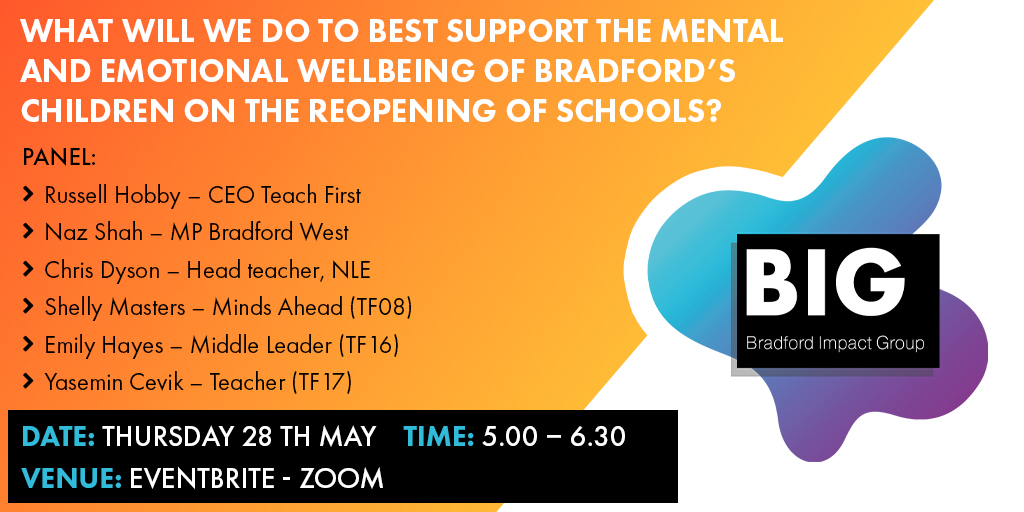
What will we do to best support the mental and emotional wellbeing of children on the reopening of schools?
My colleague Yasemin Cevik asked me to join this Teachmeet but unfortunately I had to decline her offer. Instead I wrote a quick answer to the question that is up for debate. I tried to take one particular angle, expecting that other speakers would pick up on other aspects of the answer to this question. It's about Bradford but it goes for all children:
“What will we do to best support the mental and emotional wellbeing of Bradford’s children on the reopening of schools?”
I think the key word here is ‘best’ as it acknowledges that there is no perfect way to do this – we can only do our best. As teachers we often strive for perfection – it’s because we care so much – but perfection is unattainable.
That sounds pretty pessimistic but if we want mental and emotional wellbeing for Bradford’s children then we need to pay a lot of mind to the mental and emotional wellbeing of Bradford’s education workers.
‘You can’t pour from an empty cup’, goes the saying. And it is true for this situation that we find ourselves in. Teachers who are striving for perfection and setting themselves unattainable goals are not going to experience good mental and emotional wellbeing. And, once we have more children back in (the word ‘reopening’ is incorrect – we have been open the whole time), teachers, co-teachers, leaders and other school staff are going to need to be emotionally strong and resilient so that the children have the chance of experiencing the same.
Yes, there are plenty of things we can do directly for the children: a Recovery Curriculum, as written about by Barry Carpenter (1), covers most of what school staff need to think about in terms of emotional wellbeing, and we must take care of all the logistics of keeping the school a safe place to be so as to curb the spread of virus (2). But in doing all of these things, the school staff who are responding to this unprecedented situation put their own mental health on the line.
This must be a key concern for school leaders, and for those who wish to be a supportive colleague regardless of their position. We are all in this together and everyone involved will need support. Headteachers will benefit from an appreciative word from a recently qualified teacher. Regular check-ins from a more experienced teacher will be essential for trainee teachers. Mentors and coaches will need to cast aside their regular agenda in order to focus on how their mentees and coaches are coping with the changes in policy and practice. A little encouraging message from colleagues will be a balm to the soul of members of SLT, working away in the background on the nitty gritty of wider opening.
My point is this: we can all help each other to weather this storm and as we help each other, we will be best placed to help the children. Kindness is essential at this time. Yes, kindness to ourselves – get your sleep, eat well (but don’t forgo all treats), exercise, watch your favourite series, get outside, keep in touch with family – but kindness to each other, too.
Empathy will be key. Never suppose you know how someone is feeling – although we are experiencing the same pandemic, we are not all experiencing the pandemic in the same way. Take the time to find out how people have felt during all its different stages, and make sure you know where they’re at presently. Don’t assume to know based on your own experience. This goes for staff and for children.
Much of the time when we open schools to more children should be spent in this exploratory manner. With adults it might be more obvious, with children it could be more subtle. Make time for discussions which allow children to air their views – do this in different group sizes, or 1-to-1 if necessary. Allow your story reading to flow into conversations about how the characters’ experiences mirror the children’s own thoughts and feelings. Make time for collaborative activities (they can still be socially distanced if you want to go for that), team quizzes and games and other activities where children connect with one another mentally and emotionally. Whatever the activity, allow people the chance to share, and be sensitive to their needs as they do.
We can best support the mental and emotional wellbeing of Bradford’s children on the reopening of schools by taking care of the members of staff who will be taking care of them and by knowing and taking into account of each individual’s experience of the last couple of months. Empathy and kindness will be king upon wider opening – any school who attempts anything other than this will take a hit in the years to come, both in staff and pupil wellbeing.
______________________________________________________________________________
1. Carpenter, R: A Recovery Curriculum: Loss and life for our children and schools post pandemic (https://www.ssatuk.co.uk/blog/a-recovery-curriculum-loss-and-life-for-our-children-and-schools-post-pandemic/)
2. Gov.uk: Coronavirus (COVID-19): implementing protective measures in education and childcare settings (https://www.gov.uk/government/publications/coronavirus-covid-19-implementing-protective-measures-in-education-and-childcare-settings)
Monday, 9 September 2019
From @Matr_org: Understanding Maths Anxiety: A Parents’ Guide On How To Overcome This Primary School Problem
"I remember finding ways to get out of maths lessons as a youngster.
My favourite ruse was to offer to tidy up the teacher’s cupboard – I even clearly remember stacking the maths textbooks neatly on the shelves, feeling inwardly smug that I did not have to open them and attempt the questions inside.
I recall my dad spending what seemed like hours with me trying to help me to understand negative numbers and how to calculate them – unfortunately, his pictures of eggs and egg cups didn’t help at all although I appreciated his efforts!"
https://matr.org/blog/understanding-maths-anxiety-parents-guide/
Wednesday, 13 June 2018
Guest Post: Why Tackling School Leader Workload Is Not Enough By Viv Grant
In March, Damian Hinds announced that the DfE were going to implement measures to reduce teacher workload in an attempt to head off the recruitment and retention crises facing many schools across the country.
Whilst this is a very welcome initiative, unfortunately it is much like putting a sticking plaster on a wound when something more substantial and curative is needed.
If policy makers honestly think that measures to reduce workload are all that’s needed to stem the rising tide of leavers from the profession, then this shows just how far removed they are from the beating heart of those who are at its centre - teachers and school leaders.
So much more must be done to make the role of School Leadership sustainable amidst the growing challenges our Heads face on a daily basis.
The pace and volume of change over the past decade has led to increased ambiguity, inconsistency, insecurity and staggeringly high levels of public scrutiny and personal accountability. Meanwhile, the emphasis on data, results and policies such as academisation, free schools etc have only served to further complicate life as a School Leader.
As a result, Head teachers find themselves having to respond to a range of often conflicting national policy agendas. Many of which draw them away from their central school leadership role and into the world of local politics and excessively complicated levels of bureaucracy. The strain for many can be too much.
Yet the system seems immune to this fact and chooses to ignore the real reasons as to why so many school leaders are leaving the profession. Workload may be a contributing factor but it is not the sole one. School Leaders are leaving the profession because their needs as human beings are not being attended to. This is because we have yet to develop an accurate understanding of the support needs of school leaders.
Along with increased levels of public scrutiny and personal accountability, I believe neglect in meeting Head teacher’s psychological and emotional needs has become a major contributing factor to Head teacher attrition and early retirement.
Whether Heads are new in post or are well established and long serving, too often the predominate type of support that they receive is that which is concerned with meeting the strategic and operational aspects of the role. Their emotional needs are often neglected and this is where the system falls down in fulfilling its duty of care for school leaders.
Consequently, Head teachers often sacrifice the meeting of their own needs in order to meet the needs of those they serve. This level of constant giving, without moments and opportunities for renewal built into their leadership life can often lead to illness and for some, burn out.
This has to be understood and taken seriously because if the emotional and psychological needs of school leaders are not met, not only do our School Leaders themselves suffer but all school improvement efforts are also put at risk.
I fear this situation has been further compounded with local authorities now diminishing in size, meaning that there have been fewer and fewer opportunities where Heads can come together, to offer support for one another, and experience a real sense of collegiality and shared purpose to help combat this.
I feel this reduction of support has been felt across the profession and that’s why on the back of many requests from School Leaders, last year I began hosting “Education for the Soul” Conferences to offer a chance where Heads can have honest conversations about the issues they’re facing, replenish their passion and sense of purpose, and discover how to best support their own needs amidst the challenging demands of Headship.
Whilst I’ve seen what an incredible truly restorative events these can be, I still fear far more needs to be done across the country if we are to tackle this recruitment and retention crisis. We need a whole new conversation around how we support great leadership in schools and to find solutions that takes care of the “Person in the role”.
Meanwhile, policy makers finally recognise that workload measures are not enough. Instead they must learn that if they want help create outstanding schools, they must provide School Leaders and Headteachers with outstanding support.
The price of continually failing to do so is one we can no longer afford to pay. As when we fail to adequately recognise what it takes to create ‘Great School Leaders’, we also fail our children and their hopes of a better tomorrow.
Our children deserve the best care and education and our school leaders also deserve the best care that can be provided so that they can remain in the profession, fulfil their vocations and meet society’s hopes and dreams for our future generations.
Viv has been in the education profession for over twenty five years. She is a former primary head teacher and has been a lead trainer and consultant for a number of educational training bodies. Now as an Executive Coach and Director of Integrity Coaching, Viv works daily with others who have taken on the mantle of school leadership.
Labels:
education,
emotional wellbeing,
leadership,
middle leadership,
wellbeing,
workload
Sunday, 11 February 2018
Year 11 Hell: Why More, More, MORE Is Not The Answer
Recently a secondary teacher got in touch with me asking if I'd consider sharing something he had written about something that was going on in his school. The following blog post is what I received. It details some worrying practices which appear to be impacting heavily on both student and teacher wellbeing. I echo the author's summary here: there surely is another way. Is this common practice? Are schools tackling the same issues in better ways? I'd love to hear your own experiences of this.
Year 11 students, their teachers and their parents are at breaking point. The most frustrating thing is that we’ve seen this coming for years, and we’ve done nothing about it.
It’s Saturday afternoon. In our house, the major concerns are who will win the race to the bath to warm up after my son’s football match and whether we should prepare the roast to eat before The Voice or during it. I’m wondering whether I can face the pile of odd socks which are glaring at me from the sofa. This is about as stressful as Saturdays get here.
As I write, year 11 are at school. They had English all morning then moved onto Maths. They’re in every Saturday between now and June. The rest of the school finished at 3.25 each day, but Year 11 have an extra hour at the end of each day. Subjects battle for prime positions – Tuesdays and Wednesdays. Science drew the short straw with Fridays – but the students all come, even if it does mean being rounded up and herded from their previous lesson by a pastoral team with apparent infinite patience, who must be clocking at least 30k steps a day as they prowl corridors to check on non-regular coats and chewing gum.
Last year, a respected group of educators put forward the suggestion that core PE should be pulled for Year 11, to give them more time to focus on core subjects. Thousands of schools have gone with this idea, it would seem. So, instead of running around on a field, students are filtered into English, Maths or English AND Maths depending on which week it is where the moon is in its current cycle. Trying to ensure the right students are in the right places depending on the latest half-termly data available is a feat requiring the skills of an aeronautic engineer.
After the mock results came in, the school went into panic. I can’t remember, in my ten year career, this ever not happening. ‘MORE!’ ‘We need MORE!’ MORE resources, MORE time, MORE Walking Talking mocks!’ say the heads of the core subjects. If we don’t, they’ll all fail! The school will be plunged into Special Measures if we don’t throw every spare moment, every resource, every initiative at Year 11.
So, at the end of December, tutor time for Year 11 was replaced by TTI. That’s tutor time intervention to the rest of you. Instead of spending their morning with the form tutor and fellow tutees most of them have known since Year 11, they go to Maths and Science. Instead of having a chance to read a book, finish off a bit of homework or catch up on the news, they are having extra lessons for half an hour each morning. Instead of sharing a joke or having someone who knows them really well checking in on the latest family challenge or holiday plan, their daily dose of English, Maths or Science rises in some cases to over three hours a day.
It’s a Catch 22. All schools are doing it – or at least, that’s the perception. Whatever the rating of your school, you are under pressure to be keeping up. Perish the thought that you might lose your ‘Outstanding’ rating, drop back into RI when you were only recently deemed ‘Good’ or indeed face your entire SLT replaced by a SWAT team of Future Leaders if your school finds itself once again below par. Should you dare to suggest that Year 11 might have one whole holiday without a single day in school, you might slip behind the rest.
I’m not lucky enough to teach a ‘core’ subject. I’m part of the ‘non-core’ as a historian. But I’m better off than the third tier subjects – the arts. My poor colleagues in Drama! Their new written exams are terrifying. It’s no longer a subject for students to demonstrate their creative strengths. They have to be able to analyse stage directions at length – in writing. There was a great opportunity recently to take our students to the battlefields of Northern France recently. It would have been a long weekend – they’d have missed three lessons in total. One of these would have been Science. I may as well have asked for a year off to perfect my crochet skills. Snowball chance in hell. We didn’t go.
We ‘non-core’ subjects have to fight for time with our students. ‘It’s too late!’ we are told when requesting a half day over half term. Maths, English and Science booked theirs in weeks ago! As if we are somehow being granted a huge favour by being allowed to come and work with students during the holiday we too so desperately need.
Now, there are two schools of thought on this, based on the teachers I’ve talked to. Yes, they may be doing 7 lessons a day, but that’s ALL they’re doing, say some – and we can all picture the student who can never take their coat off or get out their pen without being asked about 500 times. The one who could do with a direct intravenous shot of the sense of urgency that the rest of us are feeling. The boys who regress to the age of 5 – happens at this time of year like clockwork. The ones whose parents learn they’ve been communicating using a series of animal noises throughout the school day. The ones who will do ANYTHING to pretend it’s just not happening.
But there’s also this: I don’t go more than a couple of days these days without finding a hitherto quiet and studious student – the kinds whose name you probably wouldn’t know unless you teach them yourself - crying in a corridor. I sit them down, offer them chocolate (it usually does the trick – at least for a few minutes) and ask what’s wrong. ‘I don’t know!’ is almost always the answer. They are overwhelmed, exhausted and their struggles at home funnily enough haven’t diminished to cater for the extra demands of being in Year 11.
And then there are the students who actually love History, have always worked extremely hard, but who literally are unable to find a couple of hours at home to study, because they’re so wrung out from being stuffed like Christmas turkeys with equations, formulae and quotes from Twelfth Night.
Oh, and the teachers. Yes, them. A colleague of mine with two children under 6 at home is on her fourth Saturday at work. We all know she’s dedicated, but she seems to believe that her dedication will come into question if she doesn’t ‘step up’.
I overheard a parent of a Year 11 student telling a mutual friend that she’d like to ‘crawl into a corner and hide’ until it’s all over. The level of hysteria, the level of panic, is quite simply untenable. Only in ten years, I’ve not seen an alternative. At the moment, we are destined to send out into the workforce a generation of highly-strung individuals who have learned through experience that someone else, rather than sending them off to work independently, will always give up weekends and holidays for them, photocopy a rainforest’s worth of resources and put a pen in their hand if they can’t be bothered to root around in their bag. We bang on about building resilience and independence, but our actions – our constant supply of MORE makes these aims laughable.
Vic Goddard said recently, ‘there is always another way’. We need to find it. Now. Because all we’re doing is pouring oil onto the wreckage of the profession we love.
Labels:
emotional wellbeing,
GCSE,
pupil wellbeing,
student wellbeing,
wellbeing,
year 11
Friday, 2 December 2016
Reading the Warning Signs
We’ve all experienced the moment when, mid-work, the computer begins to automatically shut-down; it needs its updates and a restart.
Our bodies send the same messages, often in code and rarely in the glaringly obvious written-across-the-screen way of digital devices. No, our bodies are more subtle and there are positives and negatives to that.
Continue reading here at www.integritycoaching.co.uk
Labels:
emotional wellbeing,
health,
mental health,
wellbeing
Monday, 10 October 2016
Why I Care So Much About Wellbeing
But why am I so bothered?
Two reasons:
One, it saddens me to see so many teachers struggling with what can be a really amazing job. I believe teachers can have a good work/life balance - I do - and I want to help them to have it. Why? Because if we are all well then our hard work will be more effective. And because no-one should have to work to the point where they are made ill - be that physically or mentally. Which leads me onto my second reason...
Two, as a teenager my dad took early retirement due to workplace-related stress. Diagnosed with depression, I saw him become a different person. When your big, strong, fun dad bursts into the kitchen struggling through tears to breath after battling for hours with a usually-simple task you are affected for life; that's not a point I want to get to. When the man who used to get down on the floor and build the best Lego castles with you retreats and becomes distant, you, even as a child, know that things aren't right - and you don't forget it.
I have seen first hand, and lived with the effects and consequences of, how a job can come close to killing a person. He was a successful doctor at a young age; it was a job that he once enjoyed - spending your days driving the scenic roads of the Yorkshire Dales visiting patients in a classic Daimler sounds idyllic, but this is no James Herriot story. It was a job which crept in and took control - I had an inkling at the time that his boss had rather a lot to so with his decline in health. I love and respect my dad but I know the depression and associated medication has changed him. He would not wish it on anyone - it's certainly something that, suffice to say, I'm fairly keen to avoid. If I can at all avoid it, I'd rather not be a dad who goes missing for hours at a time on a winter's evening, leaving his children at home fearing for daddy's life.
So if in future you read my blog or tweets and question why sometimes I come across as forthright and opinionated, you'll know why. It's fine for you to question my authority - who am I to make suggestions about how you live your life and approach your work? But instantly dismissing my advice, and that of others, as unworkable and unrealistic could be to your detriment. I don't claim to have all the answers but my experiences have hard-wired me to seek solutions to avoid becoming overworked, stressed and even depressed. My dad would not wish upon me that which he experienced (and still lives with today). He would not wish it upon anybody.
We teachers must speak up about these issues - not in the moany, ranty way that seems to have become commonplace, but in a way that secures support and seeks change. Friends, partners, colleagues, line managers and doctors are a good place to start - they will all be able to help you in different ways. The thought that taking such actions could actually begin to be of help is often poo-pooed; I've seen it so many times on social media when I've suggested that talking to the boss might help. The thing is, by not speaking out you are making a choice - you are choosing to subject yourself to something such as my dad experienced. You are choosing to subject your loved ones to something such as I experienced. Why is that the preferred option? I do understand the difficulties involved in talking about such delicate issues but I also understand the result of the alternative; it's really not worth it.
Please, if you are a teacher experiencing unacceptable levels of workplace-related stress, get the help you need. If you are a teacher who believes you are working more than you should have to (yes, we all do some overtime, I get that), then reassess and try to make changes in your work/life balance and if you've done all you can, then you must take it further and speak to those who have the power to make changes for you. The possible results of not doing this can be devastating, even if you're not feeling it right now, that erosion of your mental health could be on its way.
I know I am not the only one attempting to do my bit for better mental health and wellbeing in education and I'd be willing to bet that most who are have similar, or worse, stories to tell. Listen to those voices - they are not against you; they are for you. Their words are impassioned because they really do care, not because they think they've got it sussed and are better than you.
Please explore the links I've included at the beginning of this blog post as they all point to other things I've written that explore some of these themes in more detail. If you would like to chat about anything then please do get in touch.
This blog post was re-blogged on the TES blog on 11th October entitled 'If all we do is rant to each other about workload, rather than seeking help, we're choosing to subject ourselves to stress': https://www.tes.com/news/school-news/breaking-views/if-all-we-do-rant-each-other-about-workload-rather-seeking-help-were
Monday, 26 September 2016
Saturday, 13 February 2016
Date Night
Tonight is date night. I say that as if it's a regular fixture in our calendar but it's not. It should be though. My wife is a stay-at-home mum of three and has recently set up her own baking business. Our evenings are taken up with book marking, macaron making and house cleaning, amongst a whole host of other chores.
Evenings out are what works for us - getting out of the house is important as it stops us thinking of all the jobs that could be done and we are less likely to be distracted by technology if we're in the pub or at a restaurant. We consider going out for a meal a luxury as we can't always afford it, and it means finding a babysitter too. Tonight we're benefitting from a kind Christmas present of Zizzis vouchers and my sister is doing the honours with the children. We're really looking forward to enjoying some good food and quality time together.
Even though we don't always get to go out, we ensure that we have a weekend night together to watch a film and have a glass of wine. We also try to spend the last half an hour of each day together, just to catch up and wind down. We've learnt that if we don't do this things get strained between us and communication breaks down. The time together is essential.
Photo Credit: EJP Photo via Compfight cc
Evenings out are what works for us - getting out of the house is important as it stops us thinking of all the jobs that could be done and we are less likely to be distracted by technology if we're in the pub or at a restaurant. We consider going out for a meal a luxury as we can't always afford it, and it means finding a babysitter too. Tonight we're benefitting from a kind Christmas present of Zizzis vouchers and my sister is doing the honours with the children. We're really looking forward to enjoying some good food and quality time together.
Even though we don't always get to go out, we ensure that we have a weekend night together to watch a film and have a glass of wine. We also try to spend the last half an hour of each day together, just to catch up and wind down. We've learnt that if we don't do this things get strained between us and communication breaks down. The time together is essential.
If you are a teacher in a relationship then you have to prioritise time with your significant other. Thankfully I have a super-supportive wife who understands the time requirements and the pressures of the job and she enables and encourages me to use time at home effectively. But this understanding is part of a give and take relationship - sometimes I have to put the work down clear the schedule and make time for what's important. If I never did this I don't think my wife would be inclined to be as supportive, and she'd have every right not to be!
Having said this I know that this is the first time in five months we'll have been out for a meal together - that is not good enough. This half-term holiday I pledge to make time for more regular date nights during term time - we can't always wait for holidays! Who's with me?
Sunday, 7 February 2016
Wellbeing Hymn
'Liturgy of the Hours' is a Roman Catholic practice which I've not time to even begin to really understand. In brief, though, it's a supporting structure designed to aid priests in focusing on God throughout the day. Modern hymn writer Stuart Townend, however, has written a song I do understand, and I'd like to share some parts of it with you, suggesting that it contains a good framework for wellbeing:
With ev’ry morning I will kneel to pray,
To be a blessing in this coming day
In ev’rything I say and ev’rything I do,
To wholly honour you.
Beginning the day with the remainder of the day in mind is helpful. Considering the manner in which you hope to say and do things before you get a chance to say or do something thoughtless, reduces the chance of speaking or acting without careful judgment. If you are mindful of being patient and kind from the outset, you're more likely to succeed in being conducive to the happiness and welfare of the children you teach and the staff who you work with.
At noon remind me through this day to give
My full attention to the ones I’m with,
Be mindful of those things around and those within,
And fully enter in.
In these days of mobile devices and addictive social media, it's easy to forget to actually interact with those who are physically present. Every single person who reads this will have been guilty of this. Face to face communication and the sharing of joys and fears, is crucial to our wellbeing - a problem shared is a problem halved.
It is better to 'fully enter in' to the job than to do it half-heartedly and at lunch time, when you're losing the will to live yet know you've still got two hours of teaching to go, it's a good time to refocus and get ready to give yourself selflessly again to the kids who need you.
And in the evening as my thoughts retell
This passing day let me remember well;
So that no bitterness takes root within my soul,
Help me to let them go.
Reflecting on the day once you're home from school can be constructive or destructive; it depends on how you reflect. 'Count your blessings' is a twee idiom, yet many would testify to its benefits. What was good about your lessons? What did you learn? Who did you help? Finding even the smallest of positive events can alter the perception of a tough day spent in school.
And if there really was nothing good, then considering how you will learn and move forward from your experiences can have the same effect. On the other hand, it's helpful to chat (with a friend or loved one) about some of the difficult scenarios you've encountered so that you can 'park' them and move on.
And in the night-time may my mind be free
To truly rest and be refreshed in sleep;
And by releasing every worry, every strain,
Be free to start again.
A great 'Amen!' goes up from teachers here. A night free of dreams about field trips gone wrong or exam results or that awful year 10 class - what we wouldn't give for that! Be it prayer, be it list-making or some other practice, having a technique for clearing the mind before bedtime will lead to a better night's sleep. Different things work for different people.
And even though we know in a few short hours we'll be considering hitting the snooze button yet again, with a routine of mindfulness such as outlined above, as your head hits the pillow, the knowledge that a day can be bearable and even enjoyable, will further relax your mind, readying you to gain from sleep's healing properties.
This hymn assumes the singer will be calling on divine power to answer the prayers contained within. In my analysis of the contributing factors to my own wellbeing I often conclude that, were it not for my faith, I would not have as healthy a way of dealing with a teacher's workload. In short, I remember that work is not the be-all and end-all and that there are more important things in life than my job.
Friday, 5 February 2016
Good Evening, Bad Day
When you've had a bad day, don't exacerbate it.
I covered an ill colleague's class today and let's just say they didn't quite live up to my high expectations. Poor behaviour, and having to constantly remind children of the standards they are expected to conform to, is something that puts me in a bad mood. I like it when children are learning, even if there is a 'buzzy' atmosphere, and if that happens I have a good day.
Maybe I need to be more resilient in these situations. And I'll reflect on that and hopefully be a little more prepared for next time.
But tonight I did the right thing. I got in my car and cranked up the Red Hot Chili Peppers (well, as loud as my ears would allow before they crackled). Once the kids were in bed my wife and I watched Liar Liar (it's on Netflix now) and had a laugh. Jim Carrey. I'm still in awe of his lunacy - my teenage obsession has not worn off. I was reminded of how in life's most serious situations there is a time for silliness. Laughter may be the best medicine, especially when shared. We drank wine. We made bacon butties. We watched a fairly thought-provoking episode of House. We did what we wanted, and felt fully entitled to it.
I also turned to Twitter this evening for advice about a work situation, knowing that if I didn't have some sort of plan of action, I'd turn it over in my mind all weekend. Because some great colleagues were willing to engage and share their thoughts, I was able to park the problem and get on with enjoying my night; the evening I deserved.
When you've had a bad day, be kind to yourself. Constructively offload and actively seek pleasure. Don't make things worse, do your bit to make things better.
I covered an ill colleague's class today and let's just say they didn't quite live up to my high expectations. Poor behaviour, and having to constantly remind children of the standards they are expected to conform to, is something that puts me in a bad mood. I like it when children are learning, even if there is a 'buzzy' atmosphere, and if that happens I have a good day.
Maybe I need to be more resilient in these situations. And I'll reflect on that and hopefully be a little more prepared for next time.
But tonight I did the right thing. I got in my car and cranked up the Red Hot Chili Peppers (well, as loud as my ears would allow before they crackled). Once the kids were in bed my wife and I watched Liar Liar (it's on Netflix now) and had a laugh. Jim Carrey. I'm still in awe of his lunacy - my teenage obsession has not worn off. I was reminded of how in life's most serious situations there is a time for silliness. Laughter may be the best medicine, especially when shared. We drank wine. We made bacon butties. We watched a fairly thought-provoking episode of House. We did what we wanted, and felt fully entitled to it.
I also turned to Twitter this evening for advice about a work situation, knowing that if I didn't have some sort of plan of action, I'd turn it over in my mind all weekend. Because some great colleagues were willing to engage and share their thoughts, I was able to park the problem and get on with enjoying my night; the evening I deserved.
When you've had a bad day, be kind to yourself. Constructively offload and actively seek pleasure. Don't make things worse, do your bit to make things better.
Thursday, 4 February 2016
Doing It With My Eyes Closed
I'm going to bed. I'm actually in bed now. A full three hours ahead of when I went to bed last night. Sometimes you've just gotta go. And that's about the long and short of it.
Our bodies do this extraordinary thing when we become tired: they behave as if they are tired. When we've had a lack of sleep, our body reminds us in rather unsubtle ways. Mine sends messages to my eye saying, "'Ere mate, if you just start twitching, and then go on doing that, y'know, at least once a minute, say, then maybe he'll realise we're knackered." My eye obliges, often for days on end. Then there's a little muscle in my arm who gets in on the twitch action. Eventually (because I have to ignore twitches, really) my eye says something along the lines of, "Enough of this, already. I'm just going to close. Oi, Righty, are you shutting too, pal?" And they agree. They don't care if I'm actually handling a motor vehicle on the public highway, or reading my daughters a story (it's equally as dangerous to fall asleep during either), they just go right ahead and clock out.
And if shock tactics don't work then my body has a secret weapon. One which had me visiting doctors last year convinced I had late-onset type 1 diabetes (it is a thing). My body sends out the message: "Right troops, time for a full assault." (Are you bored of the personification of the rest of my body yet?) And I shake and shiver uncontrollably. I can't regulate my body temperature. I wake up in the night drenched in sweat. My dreams are wild flights of delirious fantasy.
I have to listen to my body when it gets that vocal. And that's how I ensure I get enough sleep. I just do it when I need it because I know it's barely worth me dragging myself into school when my body is going at me hammer and tongs. Even with the best planned lessons, the most carefully-considered resources, the books marked in the right colour pen in a way that gives children opportunity to respond to my comments in order to deepen their understanding - even with all that, if I'm shattered then, quite frankly, I'll do an inadequate job.
To my mind a huge part of preparation for the classroom comes from hours spent asleep. Even when Ofsted come a-calling you'll find me downing tools no later than 10pm, ready to catch a whole load of refreshing and revitalising Zs. Sleep is restorative - it trumps planning and marking. With a good night's sleep under the belt I'm much more likely to make spontaneous magic happen in the classroom, magic that can't be planned for. That's what I tell myself, anyway. Seems to work.
Photo Credit: insaness via Compfight cc
Our bodies do this extraordinary thing when we become tired: they behave as if they are tired. When we've had a lack of sleep, our body reminds us in rather unsubtle ways. Mine sends messages to my eye saying, "'Ere mate, if you just start twitching, and then go on doing that, y'know, at least once a minute, say, then maybe he'll realise we're knackered." My eye obliges, often for days on end. Then there's a little muscle in my arm who gets in on the twitch action. Eventually (because I have to ignore twitches, really) my eye says something along the lines of, "Enough of this, already. I'm just going to close. Oi, Righty, are you shutting too, pal?" And they agree. They don't care if I'm actually handling a motor vehicle on the public highway, or reading my daughters a story (it's equally as dangerous to fall asleep during either), they just go right ahead and clock out.
And if shock tactics don't work then my body has a secret weapon. One which had me visiting doctors last year convinced I had late-onset type 1 diabetes (it is a thing). My body sends out the message: "Right troops, time for a full assault." (Are you bored of the personification of the rest of my body yet?) And I shake and shiver uncontrollably. I can't regulate my body temperature. I wake up in the night drenched in sweat. My dreams are wild flights of delirious fantasy.
I have to listen to my body when it gets that vocal. And that's how I ensure I get enough sleep. I just do it when I need it because I know it's barely worth me dragging myself into school when my body is going at me hammer and tongs. Even with the best planned lessons, the most carefully-considered resources, the books marked in the right colour pen in a way that gives children opportunity to respond to my comments in order to deepen their understanding - even with all that, if I'm shattered then, quite frankly, I'll do an inadequate job.
To my mind a huge part of preparation for the classroom comes from hours spent asleep. Even when Ofsted come a-calling you'll find me downing tools no later than 10pm, ready to catch a whole load of refreshing and revitalising Zs. Sleep is restorative - it trumps planning and marking. With a good night's sleep under the belt I'm much more likely to make spontaneous magic happen in the classroom, magic that can't be planned for. That's what I tell myself, anyway. Seems to work.
Photo Credit: insaness via Compfight cc
Wednesday, 3 February 2016
Room With A View
I go up, pull open the blinds, set up the little fold-out table and just sit, looking out over the city. It's not a particularly picturesque view, but essentially it's not the inside of a school; it's the outside world. And that's where I go to work interrupted (mostly). Witnessing the weather, watching the cars and cats go by - it calms me and focuses me, or sometimes just takes my mind off it all for a moment.
It's the best place I've found in the building to work after my afternoon teaching duties. It's a bit makeshift but it gives me space: physically and mentally. And a place like that is important to most of us. Our environment affects our mind, which in turn affects our ability to work. And if you can keep your hidey hole fairly secret, you'll not be disturbed that often either!
Have you found your hidey hole yet? Your little oasis of calm within the walls of the school? I'd really recommend finding it and using it on those occasions when the office or your classroom just isn't doing it for you.
A place with a window is ideal - a reminder that out there is a world which doesn't depend on what you're doing, a world which won't come crashing down if you don't get your work done. A window gives perspective. Reminds you that school isn't the be all and end all.
The cats who cross the road, back and forth, back and forth, will go on doing so. The city will continue in its frenetic activity, never really sleeping. Your world can be a bigger place than your job; a room with a view will help you to remember that.
Tuesday, 29 December 2015
What Does Pixar's 'Inside Out' Teach Us About Teacher Wellbeing? Part 2
Riley: I... I know you don't want me to, but... I miss home. I miss Minnesota. You need me to be happy, but I want my old friends, and my hockey team. I wanna go home. Please don't be mad.
Mom: Oh, sweetie...
Dad: We're not mad. You know what? I miss Minnesota too. I miss the woods where we took hikes.
Mom: And the backyard where we used to play.
Dad: Spring Lake, where you used to skate.
This is the finale of 'Inside Out'; the dialogue is accompanied by many an animated sad expression, a healthy number of tears and it culminates in a big family hug. Apparently Dacher Keltner from the University of California, Berkeley, 'helped revise the story by emphasising the neuropsychological findings that human emotions are mirrored in interpersonal relationships and can be significantly moderated by them.' However, the film heavily emphasises how we self-regulate our emotions and focuses less on the part that human interaction plays in influencing how we feel. For the purposes of the movie's concept this is forgivable but in real life if we shunned social interaction and relied on self to keep sane, I dare say we would find ourselves in a mess.
There are enough moments in the film where Riley and her parents help each other to overcome difficulties: sometimes by being 'goofballs' and acting like monkeys, and other times by playing hockey with a screwed up ball of paper or suggesting shared experiences to cheer each other up. And these are the moments I'd like to reflect on with regard to our own wellbeing.
I'd like to direct your attentions toward Benjamin Zephaniah's poem 'People Need People'. There are three verses, but here is the first:
People need people,
To walk to
To talk to
To cry and rely on,
People will always need people.
To love and to miss
To hug and to kiss,
It’s useful to have other people.
To whom to moan
If you’re all alone,
It’s so hard to share
When no one is there.
There’s not much to do
When there’s no one but you.
People will always need people.
In my previous post about 'Inside Out' I discussed how the exercise of a full range of emotions is good for our wellbeing. If this is happening then it is inevitable that there will be visible manifestations alerting others to our feelings. And when we spend time with friends, colleagues or family most of us hope that they will respond to the visual clues and ask us how we are feeling. And if you don't display your emotions, and the people around you don't notice when you do, then your wellbeing is in peril.
Benjamin Zephaniah suggests we need people 'to cry and rely on' and to moan to! 'Inside Out' shows us that once you have allowed emotions like sadness to manifest that healing actually begins when other people respond to it. Don't be afraid to let others see you in what you perceive to be weakness. There is actually great strength in admitting to others that you feel weak. Only when you admit it can you begin to become stronger, and so often that happens with the help of a best friend, spouse, partner, sibling, mentor or work mate. In those around us there can be found a wealth of experience, knowledge, and most importantly kindness, care and love. And we all need a bit of that, don't we?
For teachers it is important to identify those people in all areas of your life. Who knows you well? Who knows how much energy your pour into your job? Who has perhaps experienced the strains of the changing face of education and made it through the other side? Who do you know who appears to have a good work/life balance despite having a busy job? Who do you know who will just give you a cuppa and then sit and listen to your woes, without belittling them or waving them aside? Find that person. Actually, find a few; one in each setting you find yourself in. Find someone at work, find someone at home, find someone at the end of the phone line, and on Twitter. Wherever you are, know the people who can help you. And then talk. Make them aware of your emotions as part of day-to-day life. Not just when all comes crashing down. It's probably worth reminding yourself when you find those people that your range of emotions should come into play: if you feel happy, talk about happy things. If you feel scared, talk about what's scaring you. If you feel calm, tell them. Don't just moan. Or cry. Or rely.
And then there is your part of the deal. A relationship is two-ways. When the family's removal truck doesn't arrive, Riley cheers her parents up. When Riley sets out for her first day at school, her parents cheer her up. No matter how broken you are, you can still be a support to others. At times you might take more than you give, and vice versa. Who are the people in your life who need you? As teachers we are expected to care for the wellbeing of the children we teach and we can't escape from that - they need us. We all have colleagues; for those who are leaders it is part of your role to see to their wellbeing. We are duty-bound to moderate the emotions of those around us at school and if our own wellbeing isn't in check, we risk being ineffective in this area.
Benjamin Zephaniah reminds us in his poem that we need to live our lives with other people, sharing food, relaxing in company, learning from and playing with them. He says that other people can put us at ease and make life more appealing. 'Inside Out' reminds us that family and friends help us to deal with difficulties better than we can on our own.
For a case study in how talking about feelings helps, please read Numpty Teacher's blog post How I Stopped Drowning
Subscribe to:
Comments (Atom)


