Friday, 2 April 2021

Middle Grade Reading Round-Up: February - March 2021

Murder on the Safari Star (Adventures on Trains #3) by M.G. Leonard & Sam Sedgman, Illustrations by Ellie Paganelli (Pan Macmillan)

The third in the series, and I was ready for everything this one had to give. Hal and Uncle Nat once again meet a cast of colourful characters (some of whom you might feel like you know already) in this (dare I say it) enjoyable whodunnit for children. I think it is a fairly brave move to have a murder in a children's book, and the events of the story should rightly raise some discussion points. The book, although an intriguing mystery in an exciting setting (complete with all the animals you'd want from a safari through Mozambique, Zimbabwe and Zambia), is a good starting point for discussing good and bad, right and wrong as well as how different people might respond to death. Leonard and Sedgman have really nailed the format in a child-friendly form and those who've kept up with the series will be beginning to be adept at picking up on the clues needed to be sleuthing as they read.

'Murder on the Safari Star' is available now and features on my Children's Fiction 2021 list at bookshop.org: https://uk.bookshop.org/lists/children-s-fiction-2021

Space Oddity by Christopher Edge, Illustrations by Ben Mantle (Chicken House)

A book about life and the things that matter, all rolled up in a story about a boy who discovers he is part-alien. The last book I read by Edge was The Longest Night of Charlie Noon which I felt was aimed at a slightly older age group than Space Oddity - this new one could easily be managed by 8 or 9-year-olds. Apart from being a twist on the classic abducted-by-aliens narrative from the old days of Sci-fi this book is actually a sweet ode to human creativity. Whilst acknowledging that people have done a lot of damage to our planet, it also celebrates the beautiful things that we have created. Of David Bowie's 'Space Oddity' Jake's alien dad says: "...songs... tell us what it means to be alive. This was the most beautiful song I'd ever heard. And a human being had made it. I thought if they were capable of this, then maybe they weren't as primitive as we though they were." Every child who has ever felt embarrassment at how weird their parents can be will relate to this brilliantly-told story.

'Space Oddity' is available now and features on my Children's Fiction 2021 list at bookshop.org: https://uk.bookshop.org/lists/children-s-fiction-2021

Melt by Ele Fountain (Pushkin Press)

Two stories intertwine in the cold, unforgiving Arctic as a subtle message about climate change and human irresponsibility is passed on to the next generation. Bea is a city kid, tired of moving around with her dad's job and suffering bullying at yet another new school. Yutu lives in a remote Arctic village with his grandmother who holds to a simple, traditional way of life. After Yutu decides to try and prove himself as a hunter out on the tundra, and as Bea crash-lands a plane as she flees her father's attackers, they are brought together in the freezing environment and theirs becomes a race for survival. Those who have read and loved Bren MacDibble's books, or Nicola Penfold's 'Where The World Turns Wild' will love this, as will those who have read 'Viper's Daughter' by Michelle Paver ('Melt' is a like a modern-day version). In the mold of a classic adventure story, complete with bad guys but with a truth that must be uncovered rather than a treasure to be discovered, 'Melt' is a testament to friendship, determination and all-important know-how.

'Melt' will be published on 29th April 2021 and features on my Children's Fiction 2021 list at bookshop.org: https://uk.bookshop.org/lists/children-s-fiction-2021

City of Rust by Gemma Fowler (Chicken House)

Sci-fi again, but set in what I assume to be a post-apocalyptic world, ruined by human wastefulness. So far have humans gone with their refusal to reduce, reuse and recyle, that they have taken to flinging their trash into space. However, the poor of the earth are resourceful, and there's plenty they can do with the rubbish, so long as the Junkers can get it down to them. We meet Railey and Atti, her bio-robotic gecko in Boxville, where they are star drone racers. What they don't know is that they have been training for years - training to save the world from the revenge of those who hate the way of life in the Glass City. Fowler's creations are a treat for the imagination and although Karl James Mountford's cover is absolutely stunning I'd also love to see some artistic representations of the world we are shown in 'City of Rust'. In an original adventure, perfect for fans of Philip Reeve's Mortal Engines and Railhead books, Gemma Fowler spins a tale of loyalty, ingenuity and derring-do whilst making an important statement about the potential consequences of materialism.

'City of Rust' is available now and features on my Children's Fiction 2021 list at bookshop.org: https://uk.bookshop.org/lists/children-s-fiction-2021

The Chessmen Thief by Barbara Henderson (Cranachan Publishing)

Historical fiction - probably my favourite genre. Even more so when it is medieval historical fiction. This, set in Norway, the Hebrides and the Orkney Islands in the 12th century, is a Norse tale after Henry Treece's Viking books for children. 'The Chessmen Thief', an imagined origin story for the famous Lewis Chessmen, paints much of the culture in a positive light, including the influence of Christianity. Henderson paints a vivid picture of life for slave boy Kylan as he pines for his mother whilst plotting and scheming to make his escape. The descriptions of people, place and actions great and small are so evocative of times gone by and it is easy to feel that one is there, among the people, able to smell the sea air and feel the excitement brought about by the creation of these innovative and exquisite pieces of craftsmanship. This book is a fantastic addition to the growing number of titles focused on the Viking age, this one made more rare by not focusing on activity post-1066.

'The Chessmen Thief' will be published on 29th April 2021 and features on my Children's Fiction 2021 list at bookshop.org: https://uk.bookshop.org/lists/children-s-fiction-2021

The Life and Time of Lonny Quicke by Kirsty Applebaum (Nosy Crow)

If M. Night Shyamalan wrote middle grade fiction, then he'd write something like 'The Life and Time of Lonny Quicke'. Kirsty Applebaum has already mastered the art of making a reader feel unsettled for the whole duration of a book, and in this one she does it again. Bringing folk tale aesthetics to the modern world, Applebaum spins a supernatural story of life and death. What makes this stand out from some other children's books that might be categorised similarly, is that very little suspension of disbelief is necessary: only does the reader need to allow themselves to accept that Lifelings, people who can prevent others from dying by giving up some of their own life, are indeed real. This brilliantly-spun yarn provokes many moral questions and is a great device to really get children thinking about self-sacrifice and serving others. And once they've read it, get them to think about how clever the title is.

'The Life and Time of Lonny Quicke' will be published on 6th May 2021

If you would like Aidan to work with you on developing reading at your school, please visit his website at https://www.aidansevers.com/services and get in touch via the contact details that can be found there.

Monday, 15 March 2021

The Teachers' Point of View Podcast: Should we return back to an Education system that existed before the Pandemic?

Here are the links to my appearance on TJ Juttla's The Teachers' Point of View podcast where we discuss the question Should we return back to an Education system that existed before the Pandemic?

https://www.youtube.com/watch?v=l9EioGmbRYg

https://podcasts.apple.com/gb/podcast/the-teachers-point-of-view-aidan-severs/id1541326231?i=1000513082118

https://open.spotify.com/episode/

If you would like Aidan to work with you at your school, please visit his website at https://www.aidansevers.com/services and get in touch via the contact details that can be found there.
Sunday, 14 February 2021

Book Review: 'Front Desk' by Kelly Yang

'Front Desk' by Kelly Yang has already done its thing in the US, and now the excellent folk at Knights Of have brought it to the UK. As such it's already been reviewed plenty of times and has racked up 18,000 ratings on goodreads.com, averaging at 4.41 - all entirely deserved.

'Front Desk', a middle grade novel based partially on the author's own real life experiences as a child pairs the scariness of the immigrant experience with the optimism of a child. In parts the events are very bleak as systemic inequalities are exposed, albeit through the eyes of a young teenager who still has the power to hope for more. Indeed, Mia does more than just hope and this is a story of proactivity and camaraderie, one which celebrates the power and necessity of diversity.

Despite gut-punch moments - when Mia's parents receive the hospital bill after her mum is robbed and beaten, for example - 'Front Desk' is a joyful story, the reader always buoyed by Mia's resilience and fortitude. Her work ethic and ability to problem-solve are inspiring and, although tough to read, children will cheer Mia along through every adversity that she overcomes.

It is true, however, that some of Mia's solutions rely on dishonesty, and this should be discussed openly with young readers of the book. But, more important should be conversations around the harsh treatment of migrant workers, not only in the US but in the UK also. As well as an enjoyable read, this book could also serve as a call to action for children to find out more about the difficulties that people face when they move to a new country in search of employment. Mia and her family, as well as the 'weeklies' (the almost permanent residents of the motel), put a human face to the issue which will help children to understand and empathise with people in a similar position to that of Mia's family.

'Front Desk' is also a loud celebration of how working together, regardless of ethnicity, financial circumstances or age, should be, could be, the driving force behind society. In a world where so much of the media seems to be divisive and reductive in its messaging, it is a breath of fresh air to read something that gets it so right: with a little kindness, understanding and collaboration, things get done! And with a surprise ending that I didn't see coming, I'm all ready to read the next book 'Three Keys' which Knights Of have published simultaneously.

'Front Desk' is available on bookshop.org and is featured on my Stories From America booklist: https://uk.bookshop.org/lists/children-s-fiction-stories-from-america

Saturday, 13 February 2021

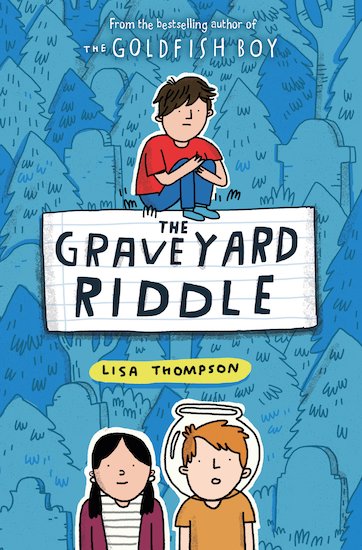
Book Review: 'The Graveyard Riddle' by Lisa Thompson

Ever since reading Lisa Thompson's first book 'The Goldfish Boy' I've been a fan of her ability to draw humour, mystery and real life together into something that children absolutely can't wait to get their hands on. In fact, in our house, she is one of only a few authors who the majority of us have read: Lisa is up there with JK Rowling in terms of how many of us have read her books!

'The Graveyard Riddle' picks up where 'The Goldfish Boy' left off, this time focusing a little more on Melody Bird as the main character. Again, Lisa deftly includes details of life's difficulties as the backdrop to the story: Matthew is still going to therapy for OCD, Melody's parents are splitting up due to a secret her dad has been keeping from them and the house has to be sold, meaning that Melody has to leave her home. Jake is being bullied by their neighbour and teacher and he is struggling with his behaviour at school - elsewhere in the book quite serious mental health issues are tackled too, as well as neglect of children. 

Although this all seems quite heavy, you'll know if you've read her previous books, that the author treats each issue carefully, sensitively, and in a way that children can relate to. In fact, if children have experienced similar things I think they would be comforted by seeing themselves in a book, and children who haven't experienced these things will have the chance to develop empathy for others who have.

But 'The Graveyard Riddle' isn't at all just a vehicle to tackle the above. Over and above that it is just a cracking mystery story, and one which really gets the reader guessing and then second-guessing themselves.

Melody meets Hal hiding out in an old plague house in a part of the graveyard that she's never visited before. Hal brings Melody into his mission: to apprehend the dangerous criminal, Martin Stone, and together they solve riddles and stake out the graveyard, spying on him as he visits. However, when Melody has to let Matthew and Jake in on what's going on, doubts are raised: is Hal really who he says he is? What is he really doing in the plague house?

'The Graveyard Riddle' is a great read for children and adults alike: Lisa is skilled at writing that dual-layer narrative that Disney does so well, ensuring that there is plenty to appeal to all. In fact, one great angle to this story is the interplay between adults and children: something which isn't always present when children are the protagonists.

Full of heart and warmth, this middle grade mystery is an easy and compelling read, perfect for children in Key Stage 2 and certainly not at all unsuitable for Key Stage 3 children either. And if you're a parent looking for a good read aloud, or a teacher wanting to stay in touch with children's literature, then 'The Graveyard Riddle' is the perfect title for you.

The Graveyard Riddle by Lisa Thompson is available on bookshop.org and features on my Read By My UKS2 Daughter list: https://uk.bookshop.org/lists/read-by-my-uks2-daughter

Thursday, 11 February 2021

Beyond SPaG: Advice For Parents When Writing With Children At Home

Hoping for a more positive response, I tweeted the above after seeing a journalist hunting for authors who were 'surprised/angered by what their children are learning about grammar, English etc during home schooling or how they are being taught to write?'. And positive response I got. By all means, click on the above tweet and explore all the answers at your leisure, or stay here and read a summary of the advice that was shared.

Before launching into the advice though, I think it would be wise to give a bit of context. During partial school closure during lockdown, teachers have been providing a remote learning experience for children who are at home. This remote learning provision, however good, cannot mimic exactly the normal ways of working in a classroom that teachers have developed; it has had to be an adapted provision. As such, it would appear that many teachers have felt that SPaG-based activities have been easier for children to complete at home; the teaching of the creative aspects of writing relying more on teacher interaction.

So, what this blog post sets out to do is provide you, a parent at home, with ways of working with your child that will help you to help your children with creative writing rather than SPaG-focused English learning. The ideas below should allow you to work with your child in a way that mirrors more closely the work that their teacher would normally do with them at school.

Reading

Many people pointed straight to reading as the first step in helping children to write. Books can inspire children and they provide a model of what a good piece looks like so they make a great starting point. The theme of reading will reoccur throughout the advice under other headings.

Imagining

Children already have great imaginations - the task for parents is to channel this imagination into their writing. People shared ideas about how to prompt children to imagine things to include in their writing:

Inspiring

An extension of imagining is using pre-existing things to generate new imaginative ideas. If it is proving difficult to capture ideas from your child's imagination then they might just need a little prompting and there are innumerable ways to do that, here are just a few:

Experiencing

Further inspiration for writing ideas can come from the experiences that your child has - it could be everyday experiences, remembered experiences or you could do something a little different to prompt their writing. Whilst experiences are limited during lockdown, getting outdoors should provide some inspiration, especially if whilst out you activate their imaginations with some 'what if' type questions e.g. 'What if this tree were the home to an army of ninja spiders?'

Talking

Writing is about the written word but before the written word there was the spoken word. The spoken word is the best starting place as it provides an opportunity to play around with language, revise ideas and collaborate. Make talk an essential step prior to writing.

Imitating

Imitation can come in many forms and children can attempt to imitate all kinds of writing. You could also work on imitating language that children hear via other media forms: audio books and TV shows, for example.
Practising

Not everything has to be a fully-blown story or piece of writing. Short bursts of writing can be a great way to develop children's writing skills and their enjoyment of writing. Keep these fun and inspiring and your child will most likely happily have a go.

Planning

Planning isn't always the most exciting part of the writing process for children, but it can be made more enjoyable. Much of this can be done orally (see the Talking heading) and can be recorded in a number of fun ways (see the Recording heading).

Recording

Once all the ideas have been thought of, there's the sticky issue of the mechanical part of transcribing all the fantastic things that children have come up with. Some of this advice revolves around writing without concern for SPaG, other ideas are to do with where children write and there are even suggestions around transcription-free writing:

Reviewing

Even in school this bit can be difficult for teachers and children - often children need a break after writing before they are ready to return to what they have written, so bear that in mind. However, it should be possible to work through what has been drafted to make improvements.
Celebrating

This is so crucial in the writing process for children - if you want them to write for enjoyment then they need to enjoy what they have written. Seeing other people enjoying their work is a great motivator too so sharing is essential! Send a copy to Granny, read it over Zoom to Uncle, drop a copy round to a neighbour - the options are almost endless and are bound to cheer someone up!
Publishing

Having a purpose for writing is also a motivating factor - one that might be considered right at the very start of the writing process, rather than as an afterthought. If children know their work will be shared, published or entered into a competition even the most reluctant writer can be spurred on in their writing.
Other Resources

Thankfully, this blog post isn't the only source of advice in this arena. Several excellent experts have produced resources to help parents help their children with writing at home:

Supporting Children Writing At Home: https://writing4pleasure.com/supporting-children-writing-at-home/

Three Steps To Writing from SF Said: http://www.sfsaid.com/2017/01/three-steps-to-writing.html

It’s A Kid’s Life – Lockdown by Kerry Gibb: http://kerrygibb.com/its-a-kids-life/kids-life-lockdown/

Writing Prompts from Beverly Writes: https://www.beverleywrites.com/blog

5 Ways to Engage Reluctant Writers with Creativity from Now>Press>Play: https://nowpressplay.co.uk/engage-reluctant-writers-with-creativity/

Homewriting Workshops from the Candlewick Press YouTube Channel: https://www.youtube.com/playlist?list=PLEqVZlLgos-WN7boUH8tsFWNihT745u9u 

Michael Rosen's videos: https://www.michaelrosen.co.uk/videos/

If you would like Aidan to work with you on developing writing at your school, please visit his website at https://www.aidansevers.com/services and get in touch via the contact details that can be found there.

Saturday, 30 January 2021

Book Review: A Vanishing of Griffins by S.A. Patrick

I have a habit of reading several books at the same time. Each of the books that I'm reading simultaneously are of a different genre so there is no confusing of plots - in fact, most of the time I only have one fiction book on the go. I think it is a very good habit. It allows me to pick and choose a book that suits my mood and, more importantly the time time of day: if I read heavy non-fiction before bed then my sleep is very disrupted, for example.

Whilst reading 'A Vanishing of Griffins' I was also reading 'Prisoners of Geography' by Tim Marshall and here's where there are further benefits of reading multiple books concurrently: Tim Marshall's book had caused my mind to think geopolitically, and so, when I picked up a children's magical fantasy book which is ostensibly rooted in a fairy tale, I saw things I wouldn't have otherwise seen.

Indeed, I noticed things about the whole fantasy genre which I'd not really stopped to consider before. Despite knowing, for example, that JRR Tolkien based much of his Middle Earth on Anglo-Saxon Britain (a time when geopolitics were surely everything, that and religiopolitics of course) I hadn't really considered how the wider genre might also represent other examples of geopolitical stories.

'A Vanishing of Griffins' is the second in the Songs of Magic series, the first being 'A Darkness of Dragons'. S.A. Patrick's latest book picks up where the story left off, and thankfully it features a recap of what has happened so far. Patch (a piper who can play magical songs), Barver (a dracogriff) and Wren (a girl cursed into the form of a rat) are in pursuit of the terrible Piper of Hamelyn who is bent on world domination, and will go to any lengths to get it. But the plot, unlike some stories aimed at the Middle Grade age group, is a little more complicated than that.

In fact, there are sub-plots a-plenty, ones which mainly revolve around mysteries that must be solved, people that must be helped and things that must be found in order for the Piper of Hamelyn to finally be found and vanquished. Reminiscent of classics of the genre - The Wizard of Earthsea, Eragon - this is an adventure quest where solutions do not come easily to the protagonists. In fact, they come up against bureaucracy and red tape as often as real-life peace-keeping missions probably do. As they travel through a world caught in the constant flux of war and peace, where power struggles are rife and political and military allegiances can change with the wind, their good vs. evil quest is a perilous and arduous one.

Whilst the backdrop may be political, the strongest theme is true friendship: the sacrifice, the willingness to go to great lengths to help loved ones, the kindness and commitment to anyone who finds themselves in need, particularly the oppressed. Wrapped up in a world of dragons, pirates and magic is an example to all children who, in reality, are growing up in a world just like the one portrayed in 'A Vanishing of Griffins'. Sure, they might not be able to call on magic to save the day, but they should be able to call on friendship.

If you are up for joining the gang on a journey that takes in being fed to a monster by a pirate king, discovering magical texts in a secret underground vault, rescuing the inhabitants of a town under fire, discovering lost relatives and fighting battles against dark forces, then this book is for you. Although, I would strongly recommend that you get hold of book 1 first to really benefit from the whole story (it can be found on my Children's Fiction - Fantasy & Magic list on bookshop.org: https://uk.bookshop.org/lists/children-s-fiction-fantasy-magic).

A Vanishing of Griffins by S.A. Patrick is available on bookshop.org and features on my MG Fiction Books January 2021 list: https://uk.bookshop.org/lists/mg-fiction-books-january-2021

Thursday, 7 January 2021

Tonight Matthew, I'm going to be... A Delivery Guy

I've contemplated writing this blog post multiple times over the last 9 months. The benefit of putting it off until now is that I can pretty much say I've been Delivery Guy in all 4 seasons, such has been the length of this horrible pandemic.

Today I was delivering laptops, but it hasn't always been devices for children who are struggling to access the online portion of our remote learning offer. I've lost count of the number of free school meals I've delivered, whether that was en masse during lockdown (pre-vouchers), or on a more individualised level for those self-isolating throughout the last term. Before that it was printed packs of learning resources when we realised that many of our families weren't able to access our online offer.

But it is never just the delivery. It's the logistics behind it too. 

Way back at the beginning of the year I sent out an online survey to parents asking them about their access to online devices (and also about their need for key worker provision in case of another lockdown). Of course, the online survey didn't fare too well for those who struggle with getting connected so there were plenty of paper copies flying around my kitchen table this week too. 

Once I'd imported (exported?) the Microsoft Forms data into an Excel document and filtered various ways to find out which families needed laptops, and once I'd added in the requests from other families, I had to check that against our list of Pupil Premium children. As I expected, the lists didn't match up - from my survey I could say that many of our PP children already had sufficient access to device, but that other children, for various reasons, did need laptops.

After some ranting and raving about the red tape involved in the government-provided laptops only being available to PP children, my principal helpfully pointed me towards our E-Learning Systems and Media Specialist who this time was doling out our class sets of Chromebooks to aid with remote learning. I sent him my numbers over and by lunchtime I had a stack of laptops checked and ready to go.

Maybe this is my perfectionism kicking in (or lack of smartphone) but I had to create myself some sort of delivery route to make the best use of my time - one Google Maps session later, I had put the local knowledge that I didn't have a year ago to work and had a great journey plan ready. That done I was ready to head off to school to pick up the laptops.

Once there, with requests for laptops continuing to come in left, right and centre, I filled in the serial numbers of the machines on all the necessary paperwork, wrote down usernames and passwords, and Post-It noted each laptop to ensure that I was giving the right one to the right family. With all that done I was ready to leave.

Suffice it to say, there were some very pleased and thankful parents and children this afternoon. The cold weather was infinitely better to work in than the sweltering temperatures of the summer (my normal work wear was not conducive to getting in and out of a car hoying around bags of bread and fruit and the like). After the disappointment of not being able to give government-provided laptops to the children who really needed them, it felt good to be making a step towards getting more children educated during this latest lockdown. Even de-tangling the snaking mass of chargers in the footwell at each stop couldn't break my good mood.

And tomorrow morning I'll go back out to spread more joy, like some kind of out-of-season Santa Claus.